DietVox Rating: AMBER
Kombucha is rated AMBER for a Weight Loss Diet, meaning it should be consumed in moderation with careful attention to portion size and frequency. The role of kombucha in weight loss is complex; while it is often marketed as a health tonic, its impact on a calorie-controlled diet depends entirely on its sugar content and how it's consumed. An AMBER rating signifies that while not strictly off-limits, kombucha contains calories that can accumulate and potentially hinder progress if not tracked carefully.
This rating is based on its variable calorie and sugar content, which can be significantly higher than the baseline values depending on the brand. It also considers its low ability to promote fullness (satiety), a critical factor for managing hunger during weight loss. This article breaks down the direct source support to help you decide how kombucha can fit into your weight loss journey.
Nutritional Profile for Weight Loss
The primary principle of weight loss is maintaining a consistent calorie deficit, where you expend more energy than you consume CDC healthy weight guidance. Therefore, every food and drink's caloric contribution must be considered.
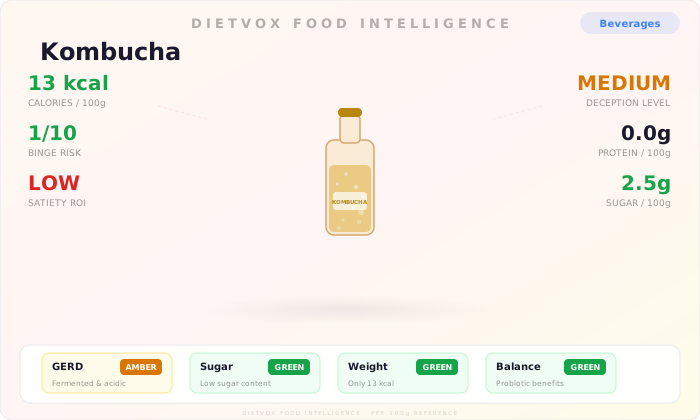
Per 100ml, a typical unflavoured kombucha provides: - Calories: 13 kcal - Protein: 0g - Fat: 0g - Carbohydrates: 2.5g - Sugars: 2.5g - Fibre: 0g
Source: USDA FoodData Central (FDC ID 174828)
The Challenge: Brand Variability
The most significant issue with kombucha on a weight loss diet is the wide variation in nutritional content between brands. While the USDA baseline is 13 kcal and 2.5g of sugar per 100ml, many commercial products contain added fruit juices and sugars to improve taste. This can elevate the sugar content to 10g or more per 100ml, making a standard 330ml bottle contain over 30g of sugar and 130+ calories. These calories are often referred to as 'liquid calories' because they are easy to consume quickly without providing a sense of fullness, making it easier to exceed your daily calorie target.
Satiety Return on Investment: LOW
Satiety, or the feeling of fullness, is crucial for adhering to a weight loss plan. Foods high in protein and fibre are most effective at promoting satiety PubMed. Kombucha contains 0g of protein and 0g of fibre. This means it offers a very low 'Satiety Return on Investment' (Satiety ROI). You consume calories without significantly reducing your hunger, which is an inefficient use of your daily calorie budget.
The Role of Probiotics and Acetic Acid
Many proponents of kombucha for weight loss point to its potential gut-health benefits. Kombucha is a fermented product containing live bacteria and yeasts (probiotics) and organic acids, primarily acetic acid—the same active component found in vinegar.
Probiotics and Gut Microbiome
There is available source reviews suggesting a link between the gut microbiome and body weight regulation Harvard Health Publishing. A diverse and healthy gut microbiota is associated with better metabolic outcomes. However, the source support that consuming the specific probiotic strains in kombucha directly leads to significant weight loss in humans is currently limited and inconclusive. More source review is needed to establish a direct causal link.
Acetic Acid
Some source reviews on acetic acid have suggested it may have modest effects on weight management, possibly by slowing stomach emptying or influencing metabolism PubMed. While promising, these effects are generally observed with controlled doses of vinegar, and it's unclear if the concentration in typical servings of kombucha is sufficient to produce a meaningful clinical effect on body weight.
It is critical to not rely on these potential secondary benefits as a primary weight loss strategy. The fundamental impact of kombucha on weight is determined by its calorie and sugar content.
Practical Tips for Including Kombucha in a Weight Loss Diet
If you enjoy kombucha and want to include it in your plan, follow these practical strategies to minimise its impact on your calorie deficit:
- Read the Nutrition Label Meticulously: This is the most important step. Ignore front-of-pack marketing claims. Go directly to the nutritional panel. Look for the 'per 100ml' values for calories and sugars. Aim for products with less than 5g of sugar per 100ml.
- Practice Strict Portion Control: Avoid drinking an entire large bottle in one sitting. A serving size of 150-200ml (about 5-7 fl oz) is more appropriate for a weight loss diet. This allows you to enjoy the flavour without consuming excessive calories.
- Use it as a Replacement, Not an Addition: The most effective way to incorporate kombucha is to use it as a direct substitute for a higher-calorie beverage like soda, sweetened iced tea, juice, or an alcoholic drink. This creates a net calorie reduction. Do not add it on top of your existing beverage intake.
- Prioritise Water for Hydration: Remember that water is the optimal beverage for hydration during weight loss, as it contains zero calories FDA added sugars label guidance. View kombucha as a flavoured treat, not your primary source of fluids.
- Track Your Intake: Due to its 'Medium' tracking difficulty, it's best to measure your portion of kombucha and log the specific brand's nutritional information into your tracking app. Do not rely on generic entries, as they may not reflect the higher sugar content of your chosen product.
By following these guidelines, you can mindfully incorporate kombucha into a well-structured Weight Loss Diet without derailing your progress.
Disclaimer: This article is for informational purposes only and does not constitute medical advice. Always consult a healthcare provider before making changes to your diet, especially if you have a medical condition.
Scan your foods with the DietVox app to get personalized ratings based on your specific dietary needs and health goals.
Last reviewed: June 2026
How It Works
Why Kombucha is Rated AMBER
DietVox rates Kombucha AMBER for a Weight Loss Diet due to a fundamental conflict between its potential benefits and its nutritional drawbacks. The rating balances its position as a lower-calorie alternative to sugary sodas against its own sugar content and poor satiety value.
- Calorie and Sugar Content: The core reason for the AMBER rating is that kombucha is not a zero-calorie food. Its calories come almost exclusively from sugar. While some brands are low in sugar, many are not. This variability requires vigilance from the consumer. Consuming a 330ml bottle of a high-sugar brand could add over 130 calories to your daily intake, equivalent to about 25 minutes of brisk walking. This can easily negate a small calorie deficit if not accounted for.
- Low Satiety: Effective weight loss foods help manage hunger. With 0g of protein and 0g of fibre, kombucha provides calories without contributing to fullness. This makes it an inefficient choice within a limited calorie budget compared to a high-protein snack or high-fibre fruit, which would provide more satisfaction for similar or fewer calories.
- Risk of Overconsumption: Kombucha often has a 'health halo' effect. Because it is associated with probiotics and wellness, individuals may mistakenly believe it can be consumed freely without negative consequences for weight. The AMBER rating serves as a caution against this mindset, reminding users that calories and sugar must always be tracked for a successful weight loss outcome.
Scan any food. Get an instant RED/AMBER/GREEN rating.
DietVox analyses every food across 4 diet protocols — no guesswork.
Try DietVox Free →Try These Instead
Safer alternatives that won't trigger your symptoms.
Frequently Asked Questions
Is homemade kombucha better for weight loss than store-bought?
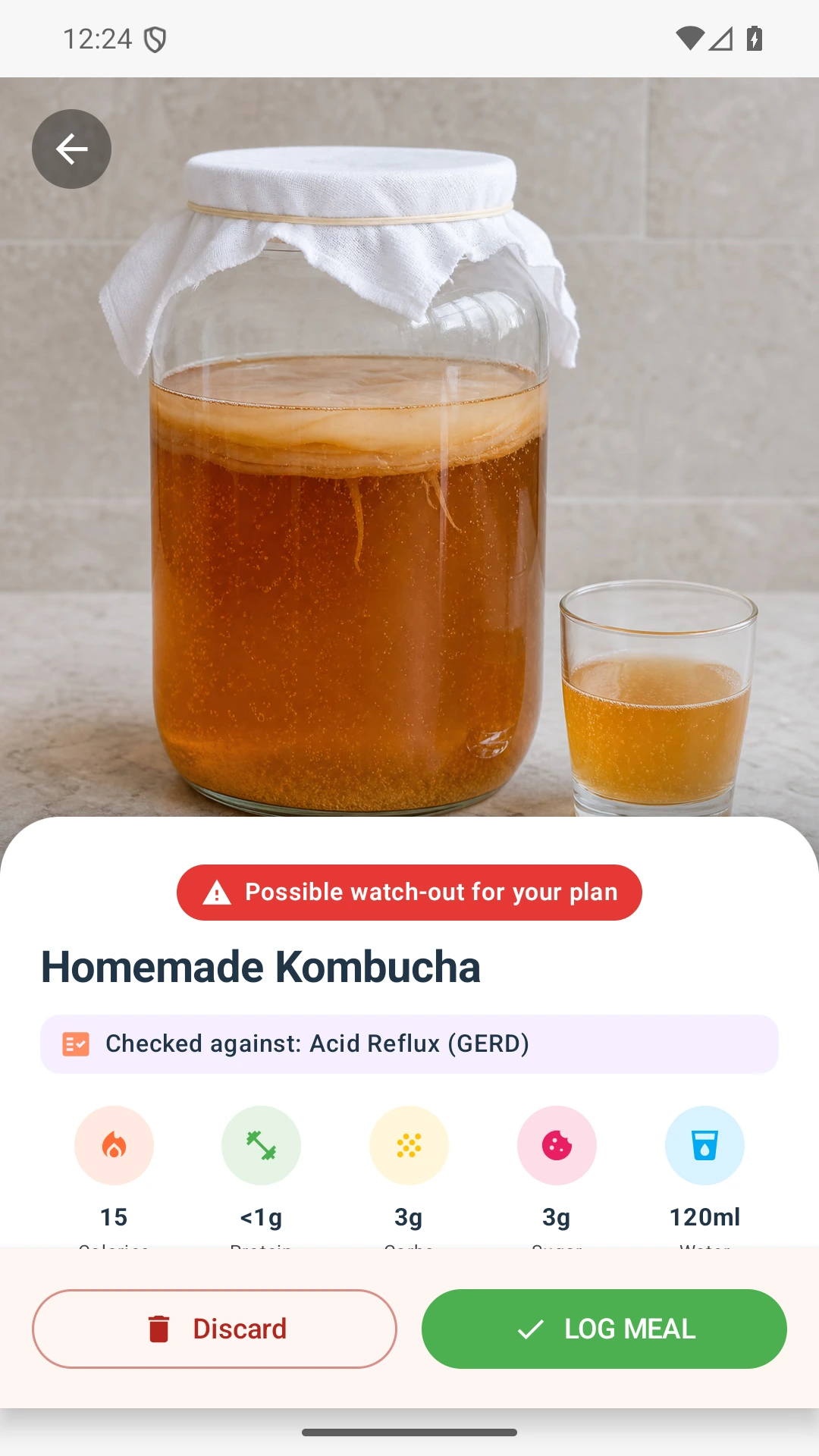
Homemade kombucha can be lower in sugar if you control the fermentation time and do not add extra sugars or juices after the initial fermentation. However, its nutritional content is less predictable and consistent than a commercially produced product with a lab-verified nutrition label. For precise calorie and sugar tracking, a low-sugar commercial brand is often more reliable.
How much kombucha can I drink per day on a weight loss diet?
There is no official guideline, but for a weight loss diet, it is prudent to limit intake to a small serving, such as 150-200ml (5-7 fl oz) per day. This amount is typically low enough in calories and sugar to fit into a calorie-controlled plan without displacing more nutrient-dense foods. Always prioritise water for hydration.
Does the 'fizz' in kombucha help with feeling full?
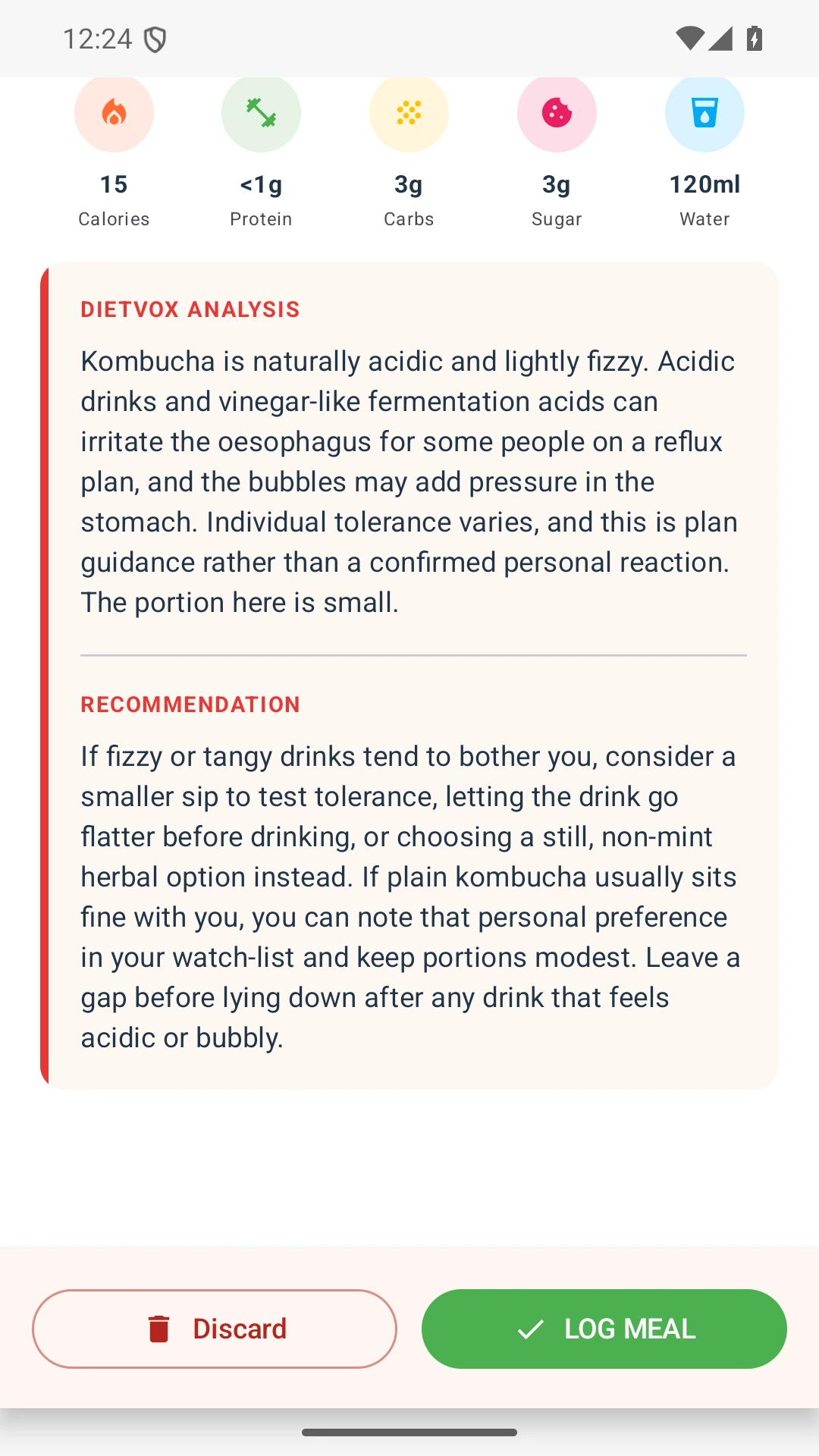
The carbonation in kombucha can create a temporary feeling of stomach distension or fullness for some people, similar to sparkling water. However, this effect is generally short-lived and does not provide lasting satiety in the way that protein or fibre does. It should not be relied upon as a tool for appetite control.
Are there any zero-calorie kombucha options for weight loss?
True kombucha cannot be zero-calorie, as sugar is essential for the fermentation process. Some brands may be very low in calories (e.g., under 10 kcal per serving) by using extended fermentation or adding non-nutritive sweeteners like stevia or erythritol. If you find such a product, it would be a more suitable choice for a weight loss diet, but always verify the nutrition label.